
Eight Arms, Endless Fantasies
This article focuses on one image from Hokusai’s erotic world. For a broader view of the artist’s life, style, and place in ukiyo-e history, see Katsushika Hokusai.
An Image Everybody Knows, and Almost Nobody Reads Correctly
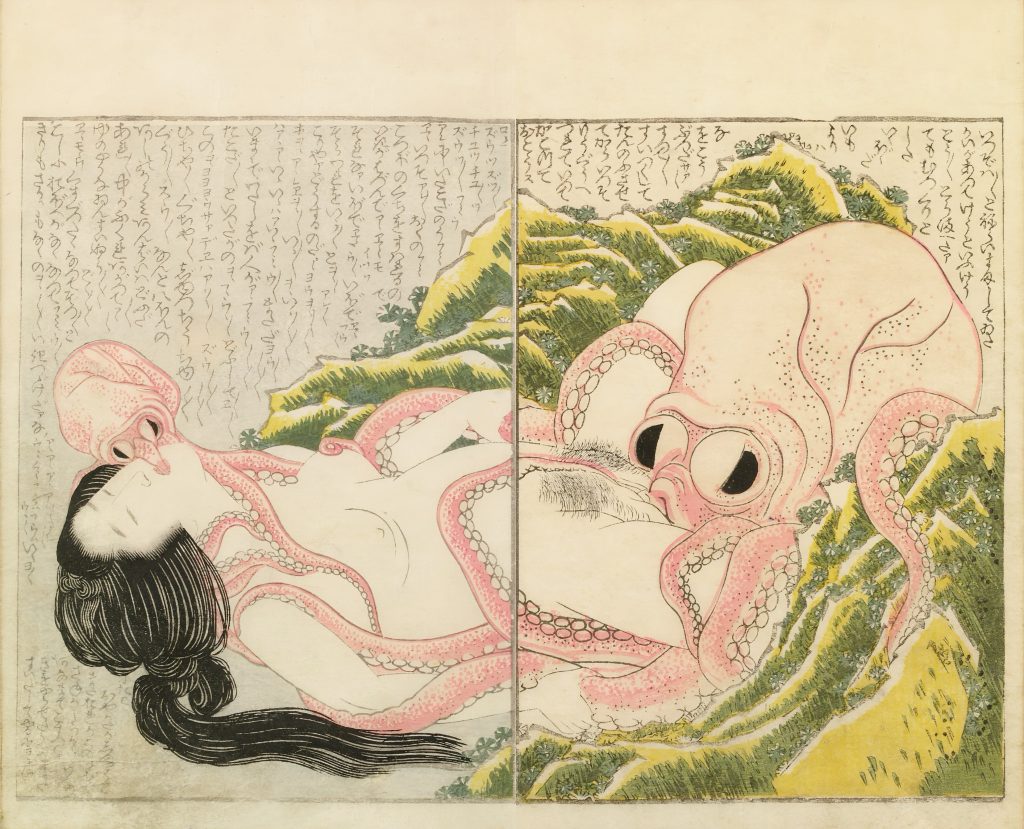
Among all surviving Shunga images from Edo Japan, none has traveled farther through the modern imagination than the octopus scene by Katsushika Hokusai commonly known in the West as The Dream of the Fisherman’s Wife.
The title itself already reveals a misunderstanding.
Japanese scholars generally prefer the simpler name 「蛸と海女」, Tako to Ama, “The Octopus and the Ama.” The image originally appeared in 1814 inside the three-volume erotic woodblock book Kinoe no Komatsu, published during the late Edo period when Hokusai was around fifty-five years old and already one of the most inventive artists in Japan.
The image originally had no formal standalone title. Edo readers encountered it not as an isolated poster but as part of a larger erotic reading experience where image, text, humor, fantasy, and literary parody intertwined constantly.
That distinction matters enormously.
Hokusai did not suddenly invent the octopus fantasy out of nowhere. Before creating this famous composition, he had already experimented several times with octopus imagery inside earlier erotic sketches and playful marine fantasies. Across those works, the erotic tension gradually intensified. Tentacles became more expressive, more tactile, more invasive, and the relationship between woman and sea creature increasingly shifted from comic curiosity toward overwhelming sensual immersion.
Seen from that perspective, The Octopus and the Ama feels less like an isolated provocation than the culmination of a long visual escalation.
The image is, in many ways, the climax of Hokusai’s octopus imagination.
Modern audiences often approach the work expecting provocation or horror. Edo viewers, by contrast, encountered it inside a sophisticated culture of erotic books where sensuality mixed naturally with comedy, poetry, theater, and visual experimentation.
The Book Beneath the Waves
The octopus scene belonged to the flourishing world of Edo enpon and shunpon, erotic illustrated books printed through sophisticated nishiki-e polychrome woodblock techniques. Ink and pigments spread across paper in carefully orchestrated layers of flesh, marine texture, calligraphy, and movement.
The title Kinoe no Komatsu itself carries the kind of literary and seasonal resonance Edo readers adored. Wordplay permeated urban culture during the Tokugawa period, and erotic books frequently layered puns, poetic references, and comic allusions beneath apparently simple surfaces.
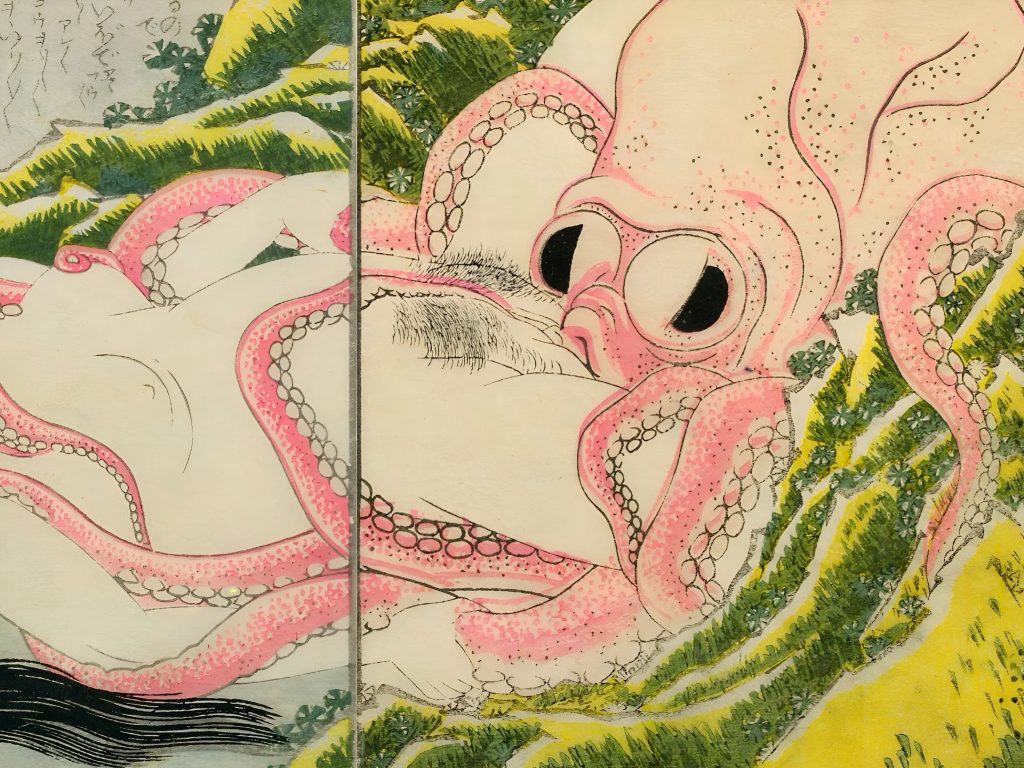
The image occupies a dramatic double-page composition. Although surviving impressions vary slightly depending on condition and print state, the visual structure remains astonishingly powerful. The enormous octopus dominates the page while the ama’s pale body radiates at the center like moonlight underwater. Around them, dense handwritten calligraphy compresses the scene so intensely that image and text almost fuse into a single organism.
Nothing remains still.
Tentacles spiral through the page in wave-like rhythms that continuously redirect the eye. Japanese criticism often emphasizes this sensation of flow. The image behaves less like a static illustration than like a current pulling the viewer beneath the surface.
The Ama and the Sea
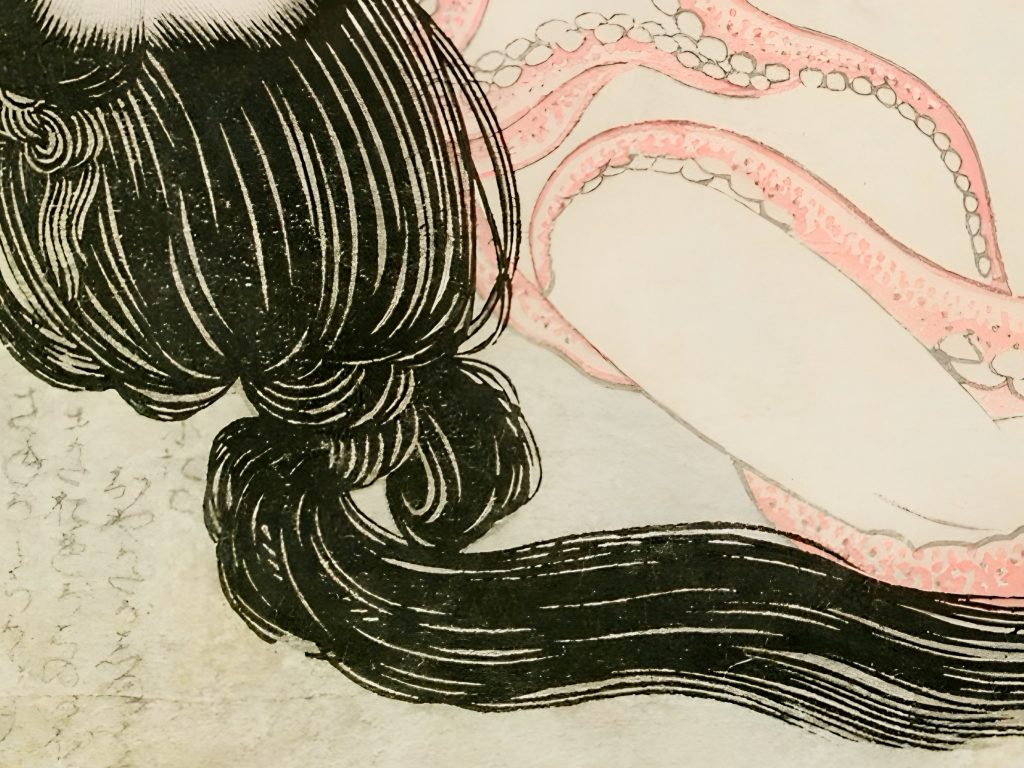
The woman depicted is an ama, a traditional female shell diver associated in Japanese culture with the sea, exposed skin, physical endurance, sensuality, and maritime folklore.
Ama occupied a curious place within Edo imagination. They were real working women, yet literature and visual culture transformed them into figures hovering between reality and fantasy. Their lives linked them physically to tides, rocks, sea creatures, and underwater danger.
Hokusai exploits those associations brilliantly.
The sea does not merely surround the woman. It absorbs her. Rocks, seaweed, tentacles, flowing hair, and pale flesh merge visually until the body itself resembles marine terrain. Human skin and octopus flesh participate in the same flowing topography.
This blending reflects broader Edo artistic tendencies where humans, animals, decorative motifs, and nature frequently interpenetrated instead of remaining sharply separated.
The Eroticism of Touch
Modern viewers often reduce the image to explicit spectacle. Edo eroticism worked differently.
The true erotic force of the composition lies in touch.
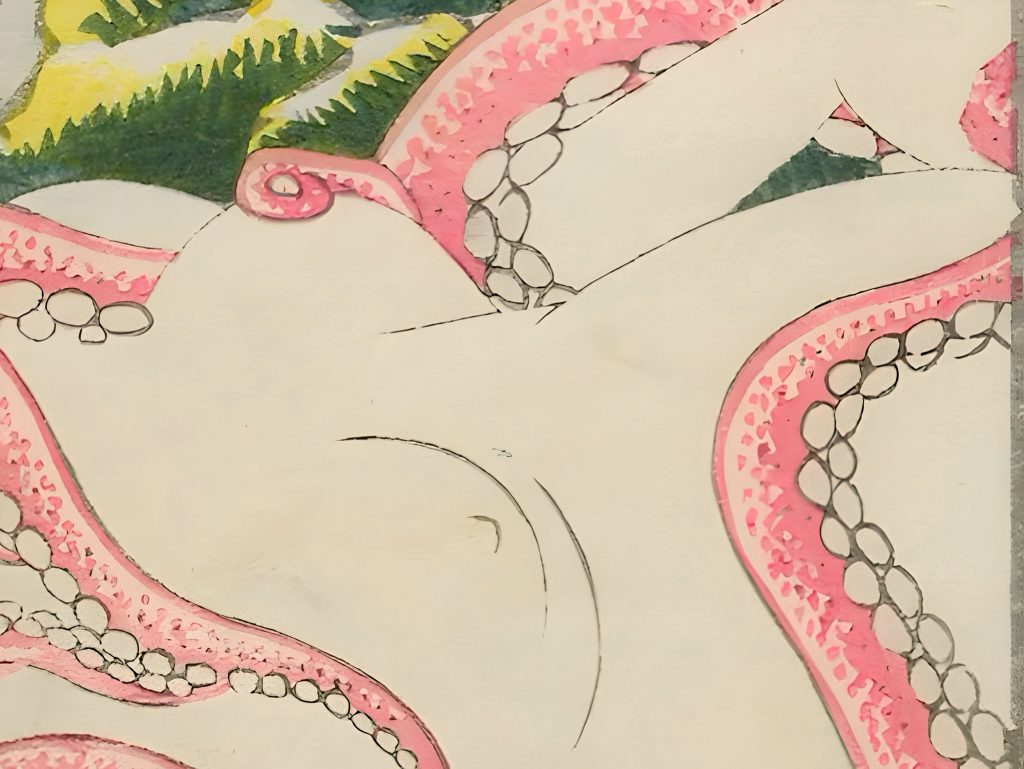
Modern Japanese scholarship increasingly describes the page through the idea of “visual touch” or haptic imagery. Hokusai constructs the image so that the viewer almost physically feels suction, wrapping, pressure, softness, swelling, and wetness.
The repeated octopus suckers create rhythmic tactile patterns across the entire composition. Curving tentacles constantly surround, envelop, and entangle the ama’s body. The eroticism therefore emerges not primarily through penetration but through total-body immersion.
One famous phrase from the dialogue praises:
「八本の足の絡み按配」
“the marvelous way the eight legs entwine.”
That line captures the central erotic logic of the work.
Hokusai eroticizes engulfment itself.
The text repeatedly returns to:
warmth,
overflowing fluids,
slipperiness,
suction,
and bodily dissolution.
One passage even compares erotic secretions to hot spring water, linking sexuality to bathing culture and thermal immersion, both deeply rooted in Edo sensual imagination.
Calmness at the Center of Chaos
One detail continues to disturb modern viewers.
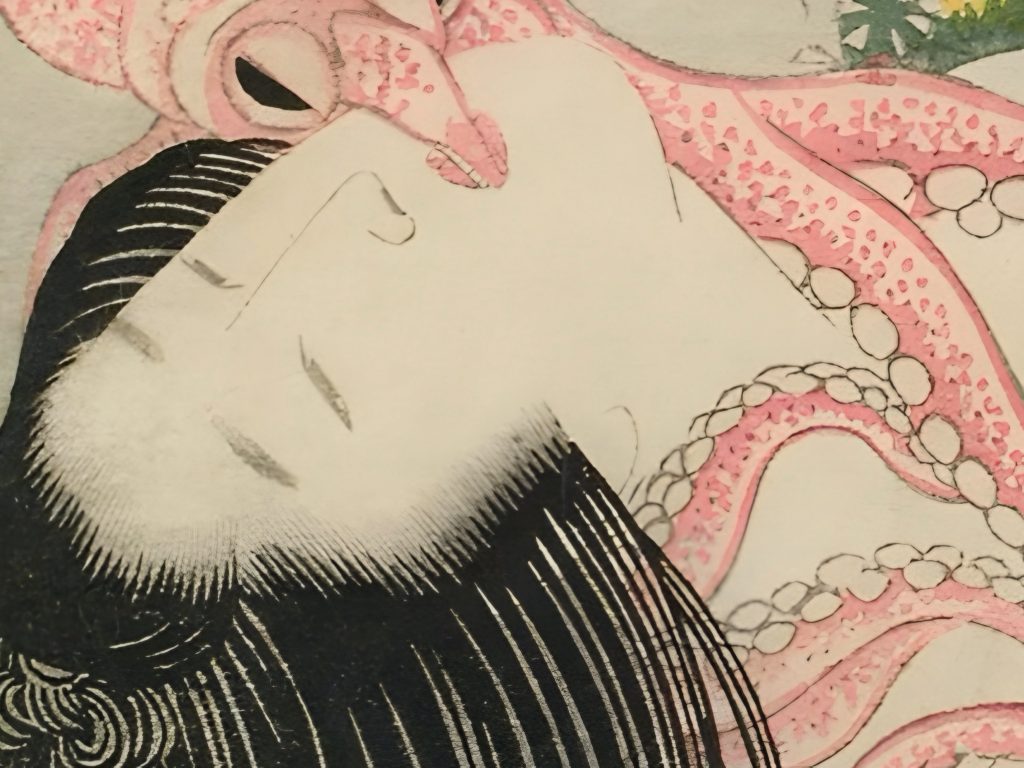
The woman does not appear terrified.
Amid the twisting tentacles and overwhelming bodily contact, her expression remains calm, dreamy, almost inward-looking. She appears absorbed somewhere between exhaustion and ecstasy.
That ambiguity forms the emotional center of the image.
Around her, everything vibrates with movement. Tentacles twist violently. Textures pulse. Calligraphy crowds the page. Yet her face remains strangely serene.
Japanese critics often emphasize this opposition between stillness and chaos. The scene feels less like an attack than like surrender to overwhelming sensation.
Edo Humor Versus Modern Tentacle Horror
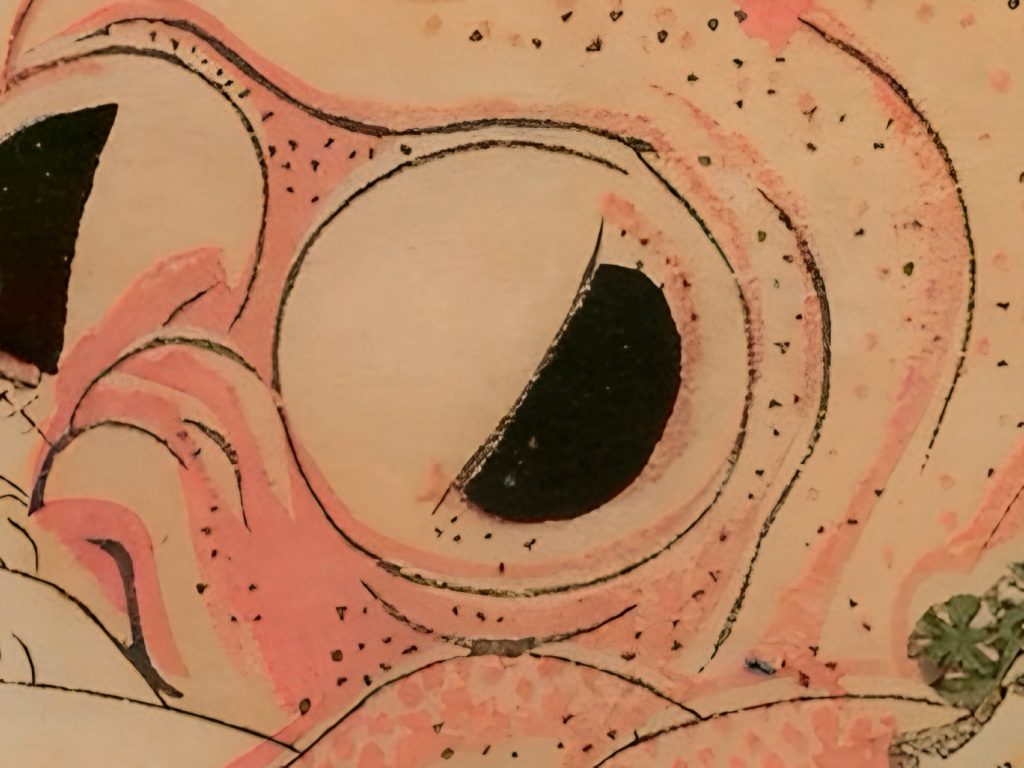
That uncertainty partly explains why the image continues resisting simple interpretation even today.
For decades, many Western interpretations framed the image primarily through horror, monstrosity, or proto “tentacle porn.”
Recent Japanese scholarship increasingly rejects those readings.
Edo erotic culture rarely separated fantasy, comedy, parody, and sensuality. The octopus scene certainly contains grotesque elements, but its tone remains playful, literary, and exaggerated rather than tragic or violent.
The smaller octopus especially contributes comic energy to the page. He behaves almost like an enthusiastic side character commenting from the wings of a kabuki stage.
Modern psychoanalytic or horror-based interpretations therefore risk erasing the Edo sensibility that originally produced the image.
The work belongs less to horror than to erotic absurdity.
Was the Image Shocking in Edo Japan?
Modern audiences often imagine scandal surrounding the work. Edo viewers likely reacted very differently.
Erotic woodblock books circulated widely despite periodic censorship campaigns. Urban readers consumed Shunga alongside humorous fiction, visual parody, poetry, and kabuki culture.
The octopus scene belonged to that commercial and literary ecosystem rather than a hidden underground world.
Some modern Japanese commentary even suggests that Hokusai may have used the provocative pen name 「鉄棒ぬらぬら」 for this publication.
Questions of authorship occasionally appear as well. A minority of scholars have proposed possible involvement from Hokusai’s daughter Ōi or workshop associates, although mainstream attribution still strongly favors Hokusai himself.
Japanese specialists also emphasize that Hokusai did not invent octopus erotic imagery from nothing. The work likely drew from older marine folklore, yōkai traditions, fantastical sea creatures, and longstanding erotic associations surrounding ama divers.
Hokusai transformed those materials into something compositionally unforgettable.
Why the Image Became World Famous
The octopus and the ama eventually escaped Edo bookshelves and entered global visual culture.
Collectors, Surrealists, psychoanalytic critics, manga scholars, Japonisme enthusiasts, and contemporary artists all became fascinated by the image. Over time it became retrospectively associated with modern tentacle imagery in manga and anime, although that connection often obscures the work’s original humor and literary sophistication.
Major exhibitions accelerated its international fame. The 2013 Shunga exhibition at the British Museum introduced the work to a vast international audience, while more recent exhibitions at the Hosomi Museum renewed scholarly discussion in Japan itself.
The image also opened wider conversations surrounding Tokugawa censorship, tactile aesthetics in ukiyo-e, female pleasure in Edo erotic books, and the relationship between comedy and sensuality in Japanese visual culture.
From there, the work naturally connects to broader worlds:
the psychological eroticism of Kitagawa Utamaro,
marine yōkai imagery,
other Shunga works by Hokusai,
and the extraordinary visual inventiveness of Edo erotic books more generally.
The Strange Western Afterlife of Hokusai’s Octopus
Few Edo-period images have had such an unexpected modern afterlife.
Outside Japan, Hokusai’s octopus scene became one of the artworks most frequently associated with the modern idea of “tentacle erotica.” During the late twentieth century, Western audiences discovering manga, anime, and Japanese erotic imagery often treated the print as a kind of historical ancestor of “hentai,” even though that modern category would have been completely foreign to Edo viewers.
That connection is partly exaggerated, but not entirely imaginary.
Modern Japanese erotic culture still occasionally returns to tentacle motifs, marine creatures, and fantastical forms of transformation. Certain JAV productions, erotic manga, illustrations, and fantasy artworks continue to reference octopus imagery directly or indirectly. Sometimes the homage is obvious. Sometimes it survives only as a visual echo.
Ironically, one of the most globally recognized symbols of “Japanese erotic imagination” is therefore not a modern manga drawing at all, but a two-hundred-year-old woodblock print created by Hokusai during the Edo period.
The image escaped its original context long ago and entered global visual culture, where it continues to generate fascination, misunderstanding, parody, discomfort, and admiration all at once.
Why the Octopus Still Refuses to Let Go
The image did not become immortal merely because it was explicit.
It survived because it remains compositionally brilliant, emotionally ambiguous, erotically inventive, and visually unforgettable.
Even detached entirely from sexuality, the page still demonstrates astonishing control of movement, rhythm, contrast, tactile suggestion, and graphic balance.
Very few artworks in world history manage to feel simultaneously comic, sensual, grotesque, elegant, absurd, and strangely beautiful.
Hokusai achieved all those sensations at once.
And perhaps that explains why, more than two centuries later, the octopus still has not released its grip on the modern imagination.
The Text Was Never Decoration
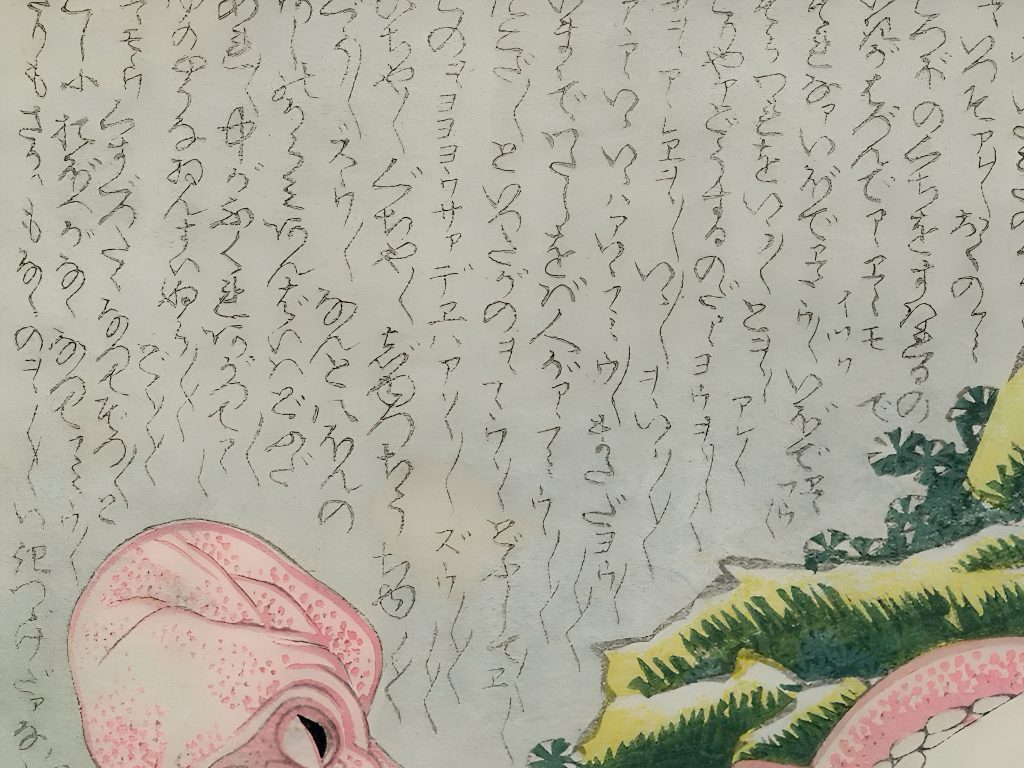
Modern reproductions often encourage viewers to ignore the writing surrounding the figures. Edo readers would have done the opposite.
The page was meant to be read.
The surrounding text consists of erotic dialogue, narration, sound effects, breath noises, comic exaggeration, and literary parody written in highly stylized kuzushiji cursive. Even modern Japanese readers usually require transcription and scholarly assistance to read it fully.
Some passages remain uncertain because surviving impressions vary and certain characters have faded over time. Modern internet translations frequently simplify, dramatize, or simply invent sections of the dialogue. More careful scholarship therefore approaches the text cautiously.
Still, several passages remain widely documented.
The larger octopus praises the softness of the ama’s body with almost affectionate delight. One famous line describes her flesh as more delightful than abalone itself, an erotic comparison rooted deeply in maritime sensual imagery.
The woman answers through increasingly breathless descriptions of pleasure:
“At last… at long last…
I have waited and waited for this moment…”
Later she gasps:
“My breath is breaking…
I’m coming…”
The smaller octopus contributes an unexpectedly comic atmosphere. Rather than behaving like a threatening creature, he sounds almost like an enthusiastic stage assistant promising that, once his “master” finishes, he too will use his suckers to pleasure the woman further.
The octopi flirt.
They tease.
They boast.
At moments, the page resembles erotic kabuki dialogue more than modern pornography.
Breath, Rhythm, and Erotic Sound
One of the greatest losses in many modern translations lies in sound.
Hokusai fills the page with breath noises and rhythmic repetitions:
「アア」
「フウフウ」
「チュッチュ」
「ズウッズウッ」
These sounds structure pacing. They force the reader to internally hear panting, suction, slurping, and repeated bodily movement. Edo erotic writing often treated sound as physical sensation.
The result feels strangely musical.
The dialogue alternates constantly between vulgarity, humor, poetry, and sensory overload. At times the text resembles theatrical chanting. Elsewhere it resembles comic monologue or erotic incantation.
One especially striking passage invokes the Dragon Palace:
「竜宮」
The reference comes from the legend of Urashima Tarō and the underwater palace of the Dragon King. Inside Hokusai’s image, however, the Dragon Palace becomes erotic fantasy itself, a place beneath the sea where pleasure dissolves ordinary human boundaries.
The fantasy therefore becomes more than explicit spectacle.
It becomes total immersion.
Sucked in Translation
“At last… at long last…
I have waited and waited for this moment,
and today, truly today,
I have finally caught you…”“What plump, splendid suckers…
Even abalone would not delight me so much.”“There now… suck, suck… drain me completely…
Let me savor it fully before
you carry me away
to your Dragon Palace
and keep me there…”Sounds from the mouth
Slurp… slurp… slurp…
Chuu… chuu… chuu…
Sluuurp… sluurp… ahhh…“Oh, what a wicked octopus you are… ahhh…”
“Ahh… deeper… there… farther inside… ahhh…
You are sucking
the mouth of my deepest secret place…
My breath is breaking… ahh… ohhh…
I’m coming…”“That’s it… with those suckers… ahhh… yes… those suckers… ahhh…”
“Ohhh… the things you are doing to me… ahhh…”
“What are you trying to do to me… ahhh…”
“OHHHH… ahhhh… yes… yes…”
“Ahhhhhhh… yes… ahhh yes…
again… again… again… again…”“Until now people mocked me… ahhh…
calling me ‘octopus woman’…
but how could they know…
how could they know…”“Sluuurp sluurp sluurp…”
Wet… squish… slick… suck suck suck…
“How marvelous the entwining
of all eight legs is…
Well? Well?”“Ahhh… inside me…
it swells and swells…”“My secret waters flow
like hot spring water…
slick… slippery… overflowing…”Throb… pulse… gush…
“Ohhh… now it tickles so deeply
my whole body trembles…
My hips have lost all strength…”“I no longer know
where anything begins or ends…
I can do nothing but climax…”“Ahhh… there… yes… yes…”
“Mmm… ahhh… good… so good…”
Little Octopus
“When master finishes with you,
then I shall use these suckers myself
and rub and rub you
from the pearl at the tip
all the way
to your hidden rear gate…
and suck every drop from you…
chuu… chuu…”
Related Reading
- Katsushika Hokusai — biography, artistic evolution, and place within ukiyo-e history.
- The Gods of Erotic Harmony — another Hokusai shunga article, focused on Manpuku Wagōjin and its bizarre erotic mythology.